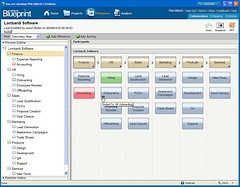
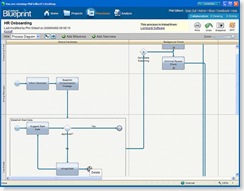
Si è tenuto nei giorni scorsi a Washington un affollatissimo convegno su Architerrure & Processi.
Sandy Kemsley era presente: se volete leggere la cronaca e i commenti sui vari interventi clicate qui
Se volete vedere le presentazioni ckiccate qui
L'attenzione al BPM è ormai un fenomeno mondiale.
Qui il link al blog brasiliano " BPM oggi".
Da notare anche in questo blog il link ai blog di Phil Gilbert e Bruce Silver.
E qui un blog da Caracas, Venezuela
Qui siamo in Cile.
E' appena stato pubblicato los studio di Bruce Silver "BPMS report" con un'analisi dei migliori prodotti BPMS.
Ecco cosa dice Bruce:
"I’ve just finished the BPMS Watch Ratings, a comparative scoring of the 11 leading BPM Suites written up in my BPMS Report series on BPMInstitute.org. Those reports, which are available for free, include
Appian, BEA, Cordys, EMC, FlowCentric, Global 360, Lombardi, Oracle, Singularity, SoftwareAG/webMethods, and TIBCO. I would have liked to get Pega and Savvion - they declined."
Nello studio Lombardi-Teamworks è risultato il migliore prodotto, detto con le parole di Bruce :
"Based on our analysis, the leader whenconsidering a single BPMS for all type of process are Lombardi e BEA"
Qui un'articolo che ne parla.
Se volete una copia dello studio potete scaricarla dal sito del BPM Institute qui oppure chiedetemelo e ve lo invio.
Qui trovate 5 bei video-demo di Teamworks e Blueprint
http://www.lombardisoftware.com/bpm-software-brochures.php#
Buona visione

La conferenza annuale utenti di Teamworks si terrà quest'anno a Austin dal 16 al 19 giugno.
Per dettagli e per iscriversi cliccate qui.

Il 7 aprile durante il meeting IBM impact in LAs Vegas IBM ha annunciato "nuova BPM suite"; eccone un autorevole commento dal blog di Bruce Silver.
Estrapolo alcune delle frasi più interessanti:
...so what is the new offering announced today? It’s called the “IBM BPM Suite” (look ma, no branding!) and it includes both WebSphere and FileNet (with some Rational and Lotus, as well). Does that mean they’ve finally integrated the components? Not really.....
...clearly IBM is interpreting the word “suite” to mean a portfolio rather than an integrated platform...
...one of my biggest complaints about the WebSphere BPM story has been the jarring discontinuity between Modeler and WID - different process metamodels, different data models, different programming models, no roundtripping.....
Se volete leggere la versione integrale del post dal blog di Bruce Silver cliccate qui
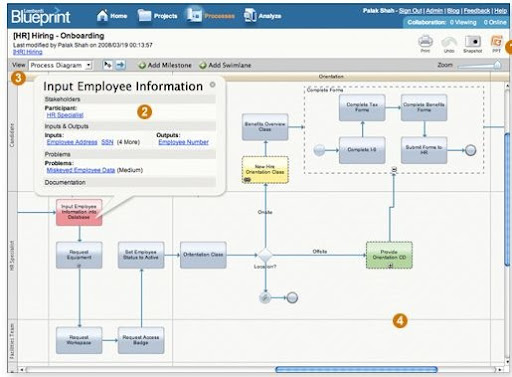
Nel corso della web conference del 2 aprile Phil Gilbert ha annunciato e presentato la nuova versione di Blueprint e ha comunicato l'attuale numero di clienti: 2400 con 5 utenti ognuno in media.
Le novità più salienti in Blueprint sono:
Per accedere a Blueprint (gratuitamente) cliccate qui.
Il 2 aprile la Lombardi ha organizzato una web conference aperta agli analisti per presentatre le ultime novità.
Sandy Kemsley era presente e ne ha scritto nel suo Blog qui
 Un recente studio Forrester Research su circa 500 aziende (USA e Europa) ha rilevato che circa il 60% hanno in essere progetti BPM e che altri 19% prevedono di iniziarli entro 12 mesi.
 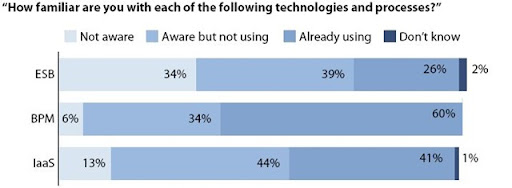 Questo 79% ha superato l'analoga percentuale di adozione di SOA.
In un altro survey su 164 aziende (USA e UK) condotto nell'ottobre 2007 più ell'85% delle aziende intevistate aveva in essere o pianificava nei mesi successivi un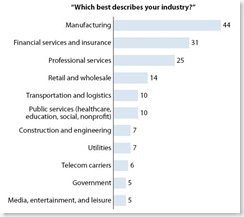 progetto BPM.
Ecco la ripartizione per settore delle 164 aziende (USA e UK). Notare il 31% di banche e assicurazioni.
Molto interessante anche l'indicazione sul beneficio primario ottenuto dai progetti BPM.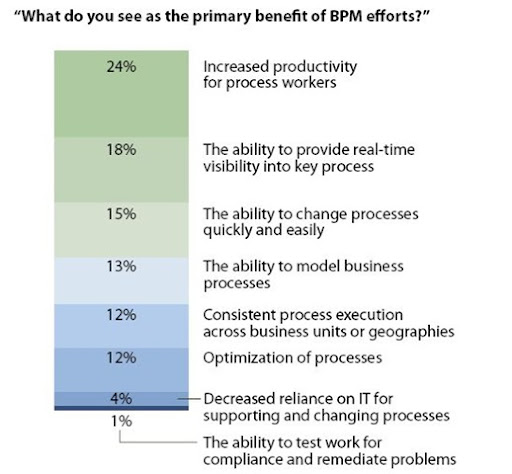 La maggioranza delle aziende per misurare il successo di progetti BPM utilizza metriche: eccone la ripartizione.
Se volete leggere il report completo mandatemi una mail e ve lo invio.(giorgio.anselmetti@ariannaconsulting.it)
Una delle classiche domande durante gli incontri con prospect è sulla differenza tra BPm e Workflow.Qui riporto la posizione di Jin Sinur, a suo tempo guru in Gartner e ora Chief Strategic Officier in Global 360.

Many folks that I have talked to in the past think that there is no difference between workflow and BPM. I would like to examine the arguments around this statement. It’s not quite so simple to say they are the same because of the scope of BPM versus workflow, and it’s hard for folks with a workflow history to see the difference.
The Workflow View:
The workflow view says that work does flow in a process, so BPM is obviously workflow. It might be a bit fancier in the technologies that surround and enable process activity, but BPM is truly workflow. Workflow, as a technology, handled the work that was passed from one human to another.
Early instantiations of workflow were software implementations of passing multi-part carbon-paper-laced forms around, (designed before copiers, carbon paper was fused between multi-colored paper copies to duplicate through pencil/pen pressure on the top form), except these forms are now digitized. We have come far and are saving trees now, so content-based workflow is viewed to be the grand-daddy of BPM.
The Workflow Management Coalition (WfMC) is active in BPM, so BPM must be purely and simply “workflow on steroids”. I even used this analogy to avoid the arguments with workflow types.
The BPM View:
I think to say that workflow and BPM are one in the same is a bit outlandish, myself. Yes, work does flow inside of BPM technologies most of the time. It’s not true that work flows when sharing and collaborating within a case folder for knowledge workers because there is no flow. Each worker does their thing on a shared set of information that may or may not have activities completed on them. I think there are two other fundamental differences.
First, BPM is more than work flowing; it’s a practice and a discipline. BPM is a management practice that treats processes as a corporate asset in order to attain the goal of improving business agility and operational performance while staying compliant. Also, BPM is a discipline that employs methods, rules, metrics, practices and software tools to manage and continuously optimize an organization’s activities and processes in light of management strategies, decisions, policies, goals and tactics.
Secondly, BPM is agile, real time, can include deep system activities, and is visible. Workflow does not employ rules and Service Oriented Architecture (SOA), which are essential for running agile activities. In the pursuit of constant optimization (saving as much time and money as possible under a set of changing conditions), BPM employs real time, complex events that can be initiated outside the scope of the process and allows for management to visibly see the effects of work completion and outside activities’ effect on the results.
Bottom Line:
Like it or not, there is an implicit link between workflow and BPM; but BPM is so much more than just “work flowing” AKA workflow. The discipline is going to a level of sophistication that business professionals demand and the technology is much more than workflow. These concepts are connected in the same family as process activity, but workflow is like the “horseless carriage”. BPM is the high performance vehicle for a number of needs.
Potete leggere il Blog di Jin Sinur con i commenti al suo post qui
Navigando ho trovato una definizione molto carina. La lascio in inglese dove suona meglio:
Workflow is "doing things right"
BPM is "doing the right thing"
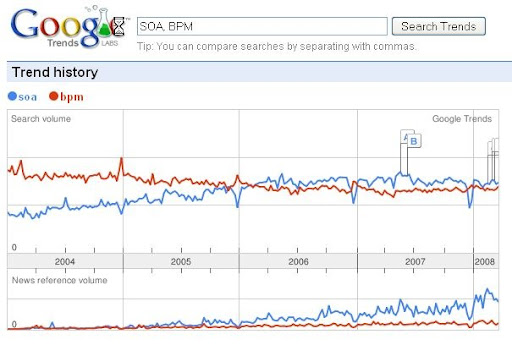
Ecco i grafici relativi alle ricerche e alle news su "SOA" e "BPM "così come evidenziati da Google.Trend
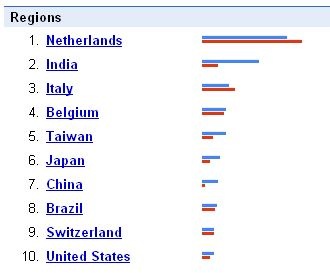
Interessante anche la provenienza: sembra che in Italia ci sia finalmente interesse per l'argomento.
Riprendo integralmente un articolo di Sandy Kemsley, apparso su "Intelligent Enterprise"
The model-driven approach and new SaaS-based offerings are sparking interest in business process management technology, but the recession may send demand over the top.
By Sandy Kemsley
A few key themes are emerging as the latest drivers of business process management initiatives. First and foremost, model-driven applications are increasingly seen as the wave of the future. Second, software-as-a-service-based offerings are starting to emerge, opening up BPM to midsized enterprises. Third, BPM in a technology that can actually thrive in an uncertain economy.
The Appeal of Model-Driven Approaches
Model-driven architecture enables a platform-independent model of business functionality to be created independently of the underlying technology. Importantly, the modeling environment is geared toward nontechnical business people. This decoupling of business logic and technology lets business people get in on the act of application/process definition since the models are understandable and don't require inclusion of the technical implementation details. But model-driven apps aren't just powerful because business people can create a models; they're powerful because those models can actually be translated directly into executable code, sometimes with only minor technical modifications.
BPM suites (BPMS) are a prime example of a model-driven application; graphical process models are typically created by business analysts using a standardized notational format such as Business Process Modeling Notation (BPMN). That model, similar to a flowchart view of the process, is easily understood by business users, yet it contains enough information to support a relatively painless and swift conversion into an executable process in the BPMS engine. If integration with systems are required, an IT person will likely be
involved to connect specific tasks in the process through Web service calls — often just matching of input and output parameters — but generally little or no code needs to written in order to create an executable process.
At Allianz of America, for example, the business owns the process and maps it down to a specific level of detail before turning it over to IT people who "move it over to the BPM tool" says Tim Rofling, IT Director of Allianz of America Shared Services. Relying on an interative methodology and focusing on small projects with a potentially big impact, the company has managed to implement an impressive number of processes, each within a 60- to 90-day timeframe. Examples include securities application processing, money processing for applying premiums and life insurance underwriting. In a new (insurance) product implementation, Rofling says cycle times to implement new products were reduced from more than 50 days down to 12 days largely because the model-driven approach removed IT development bottlenecks.
Moving to a model-driven approach changes the entire application development cycle: not only do business and IT people collaborate on modeling the business processes, the same model is then used to monitor and manage the processes in real time once they're in production.
BPM and SaaS
Software-as-a-service (SaaS) is no longer seen as risky technology. In fact, it's downright mainstream to the many organizations using systems such as Salesforce.com to manage their confidential customer information.
SaaS is used for a number of reasons: to reduce the up-front cost of systems and the IT infrastructure required to support them, to pilot the use of a system or technology without making a major investment, or to
bypass the long cycle time of a new system implementation within a large organization.
A few BPMS offerings are starting to appear via a SaaS model, with more expected during 2008. In some cases, these are pre-packaged applications built on a BPMS platform. For example, Enkata offers a contact center application based on Lombardi's BPM suite while Lawactive has legal applications built on Metastorm powered
workflows. SaaS-based BPMS platforms are also becoming available, such as Appian Anywhere and Fujitsu Interstage.
Although it's unlikely that most large organizations will use a SaaS-based BPMS platform in the near future, the attractive pricing structure allows small- and midsized-businesses to take advantage of technology that might not have been previously within their financial grasp.
BPM and the Economy
Given the increasingly bleak economic projections for 2008, Gartner and other analysts are predicting a slowdown in IT spending in most categories (although they're still expecting nominal growth in IT spending overall). Bucking this trend, however, will be expenditures on BPM and related technologies, which will be significantly above average thanks to interest in running businesses more effectively and efficiently.
The predecessor technologies to BPM, such as human-facing workflow, became popular in previous economic downturns for precisely the same reason: automating tasks and reducing handoffs within business processes can reduce the headcount required to complete those processes. In fact, until 2002 when the drive for compliance struck most large organizations, improving productivity — either for the purpose of reducing headcount or increasing capacity — was the primary driver behind most BPM implementations. The past three
to four years of economic growth have shifted the focus of many BPM implementations to providing greater agility and visibility into business processes, but increased efficiency is usually assumed to be underlying
benefit of every deployment. As belts tighten, the interest in BPM will swing back to productivity improvement.
Sandy Kemsley is an independent systems architect specializing in business process management, Enterprise 2.0, enterprise architecture and business intelligence.
 Il suo interessantissimo Blog lo trovate qui

Il titolo suonerà un po' strano ma vi consiglio la lettura di queste osservazioni riprese da un blog americano.
"SOA has more traction these days than BPM does. SOA tools are more mature, but they are also wildly technical. If you want to model a process in an EAI or ESB tool, don't expect to share that model with the business. BPMN is a visual language invented by people who like flowcharts.
Clue #1: the business hates flow charts.
There is value in connecting BPM to SOA, but it is entirely possible to do one without the other.
BPM can be performed for reasons that have nothing to do with IT automation. You can focus on improving the processes in the assembly of a manufactured product, or make the manual steps in a paper-based order processing system efficient. However, to truly unleash the power of BPM, you need to get past the biggest hurdle to it's effectiveness: the expensive IT project.
Many Business Process Re-engineering efforts die on the vine because the first step is to create a model for a new business process, and the second step is to change the IT applications that support the existing process. Step 2 becomes expensive and time consuming. The business looks at the return on investment for fixing the process, and the annual cost of making the change to IT, and is unlikely to see any real value in making the change at all.
Connecting BPM to SOA makes BPM work. We can deliver a process change FAR less expensively if it means creating a new composite than if a process change was to drive an altogether new IT system. SOA without the justification of business change is a chaotic and expensive animal that should be killed. In many companies, it has been killed as an expensive waste of time.
The only value we can get out of SOA, in the long run, is if we make the business more agile by removing the obstacle of expensive IT development. We don't need pure SOA. We need BPM+SOA.
Unfortunately, most EAI-based tools are written the other way around. We (tool vendors) expect our customers to build the services first, and then attach them to business processes in a great big flow chart. Head's up. Doesn't really work that way. In that model, the process diagram is the last thing you build. It needs to be first. Without the diagram first, you can "describe" the conceptual services you need, and even build the base infrastructure, but you cannot build the enterprise services without starting from the business process and working toward the service. Seamlessly.
In this paradigm, BPMN is a problem. EAI tools support BPMN as a flow chart (see clue #1 above).
If we will see the BPM+SOA concept take off, it won't be because we decided to teach a million businessmen to read BPMN flow chart diagrams. BPM+SOA will take off when we learn to develop SOA models from the business process diagramming standard that business already uses: the swimlane diagram.
Let me repeat for clarity: we should attach SOA to the Swimlane Diagram, not business process to the BPMN flowchart.
There are already tools on the market that take this approach and many more are appearing. This is the direction that many software vendors, including my own, have been slow to understand.
Cracking this nut will require that we start where the business is, enable a higher level of immediate quality and consumability where the business is, and THEN tie in IT where the services are. Starting where the business is requires a new tool. Building the services will use the existing tools. We are half way there.. ... but only half way there.
Update for clarity: Yes, I know that BPMN allows you to model a swim-lane diagram. Swimlanes are a problem in the EAI space, however, because we didn't put people into the process from the start. In many tools that started from the EAI space, the swimlane is the afterthought and human collaboration semantics are not well managed. This includes things like worklist, notification, team assignment, handoff, ad-hoc routing, and other elements that are typical of workflow tools that do not show up in EAI tools"


Their initial drivers for BPM date from 2005:
They’ve implemented an impressive number of processes in a short time:
They have a number of other ones lined up for implementation in 2008
He ended with some lessons for success:
They keep the BPM project teams small, and have found a great deal of improved efficiency through their implementations. They have a BPM center of excellence that they use to train the business side. The technical teams have done the Lombardi technical training, and found that the week-long training was adequate for their needs. He wouldn’t talk openly about their vendor selection process, but stated that there were significant differences between BPM products. The business owns the process and maps it down to a specific level of detail (in Blueprint, I believe) before turning it over to IT who “move it over to the BPM tool” — presumably, they’re using Blueprint for modeling by the business, which still requires export/import to get to Lombardi’s TeamWorks execution environment, so round-tripping would definitely be impacted.


When evaluating software vendors, make sure that a Proof of Concept (POC) is part of your process. We just completed an intense vendor assessment between three BPMS (Business Process Management Suite) vendors. All three vendors have great products and plenty of successful customers. It wasn't until we entered the Proof of Concept phase when one of them separated from the pack.
In our POC we made the vendors start with a blank screen and build a sample process flow that we modeled on paper. We chose a model that exposed various features and functionalities of the BPMS tools. We where looking for ease of use, how quickly each vendor could complete the POC, and how the tools integrated with our existing .Net services.
What we found is that only one of the vendors could actually complete the POC in the one day event and that same vendor was the only one who could even figure out how to connect to our services. In fact, it was so easy for this vendor that we gave them additional services to connect to and they were able to accomplish that also.
The lesson learned here is you need to do more then just submit and analyze RFI's and RFP's. Vendor demos are not enough either. If we had not asked them to do a POC we would have selected a different vendor who could not easily integrate with our infrastructure. This would have raised our Total Cost of Ownership (TCO) and reduced our ability to improve speed to market.
When it is all said and done, the proof is in the pudding!