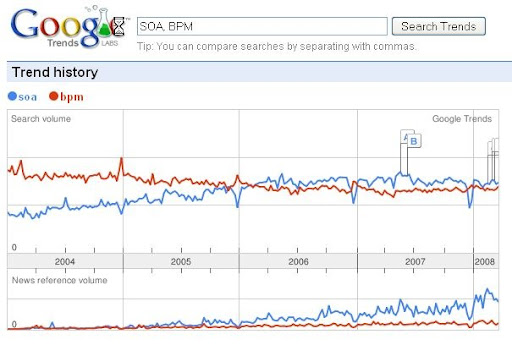
Ecco i grafici relativi alle ricerche e alle news su "SOA" e "BPM "così come evidenziati da Google.Trend
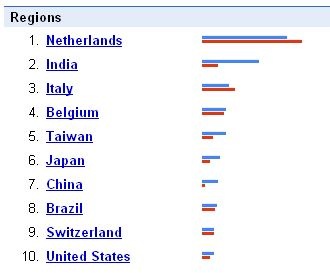
Interessante anche la provenienza: sembra che in Italia ci sia finalmente interesse per l'argomento.
Ecco i grafici relativi alle ricerche e alle news su "SOA" e "BPM "così come evidenziati da Google.Trend
Interessante anche la provenienza: sembra che in Italia ci sia finalmente interesse per l'argomento.
Riprendo integralmente un articolo di Sandy Kemsley, apparso su "Intelligent Enterprise"
The model-driven approach and new SaaS-based offerings are sparking interest in business process management technology, but the recession may send demand over the top.
By Sandy Kemsley
A few key themes are emerging as the latest drivers of business process management initiatives. First and foremost, model-driven applications are increasingly seen as the wave of the future. Second, software-as-a-service-based offerings are starting to emerge, opening up BPM to midsized enterprises. Third, BPM in a technology that can actually thrive in an uncertain economy.
The Appeal of Model-Driven Approaches
Model-driven architecture enables a platform-independent model of business functionality to be created independently of the underlying technology. Importantly, the modeling environment is geared toward nontechnical business people. This decoupling of business logic and technology lets business people get in on the act of application/process definition since the models are understandable and don't require inclusion of the technical implementation details. But model-driven apps aren't just powerful because business people can create a models; they're powerful because those models can actually be translated directly into executable code, sometimes with only minor technical modifications.
BPM suites (BPMS) are a prime example of a model-driven application; graphical process models are typically created by business analysts using a standardized notational format such as Business Process Modeling Notation (BPMN). That model, similar to a flowchart view of the process, is easily understood by business users, yet it contains enough information to support a relatively painless and swift conversion into an executable process in the BPMS engine. If integration with systems are required, an IT person will likely be
involved to connect specific tasks in the process through Web service calls — often just matching of input and output parameters — but generally little or no code needs to written in order to create an executable process.
At Allianz of America, for example, the business owns the process and maps it down to a specific level of detail before turning it over to IT people who "move it over to the BPM tool" says Tim Rofling, IT Director of Allianz of America Shared Services. Relying on an interative methodology and focusing on small projects with a potentially big impact, the company has managed to implement an impressive number of processes, each within a 60- to 90-day timeframe. Examples include securities application processing, money processing for applying premiums and life insurance underwriting. In a new (insurance) product implementation, Rofling says cycle times to implement new products were reduced from more than 50 days down to 12 days largely because the model-driven approach removed IT development bottlenecks.
Moving to a model-driven approach changes the entire application development cycle: not only do business and IT people collaborate on modeling the business processes, the same model is then used to monitor and manage the processes in real time once they're in production.
BPM and SaaS
Software-as-a-service (SaaS) is no longer seen as risky technology. In fact, it's downright mainstream to the many organizations using systems such as Salesforce.com to manage their confidential customer information.
SaaS is used for a number of reasons: to reduce the up-front cost of systems and the IT infrastructure required to support them, to pilot the use of a system or technology without making a major investment, or to
bypass the long cycle time of a new system implementation within a large organization.
A few BPMS offerings are starting to appear via a SaaS model, with more expected during 2008. In some cases, these are pre-packaged applications built on a BPMS platform. For example, Enkata offers a contact center application based on Lombardi's BPM suite while Lawactive has legal applications built on Metastorm powered
workflows. SaaS-based BPMS platforms are also becoming available, such as Appian Anywhere and Fujitsu Interstage.
Although it's unlikely that most large organizations will use a SaaS-based BPMS platform in the near future, the attractive pricing structure allows small- and midsized-businesses to take advantage of technology that might not have been previously within their financial grasp.
BPM and the Economy
Given the increasingly bleak economic projections for 2008, Gartner and other analysts are predicting a slowdown in IT spending in most categories (although they're still expecting nominal growth in IT spending overall). Bucking this trend, however, will be expenditures on BPM and related technologies, which will be significantly above average thanks to interest in running businesses more effectively and efficiently.
The predecessor technologies to BPM, such as human-facing workflow, became popular in previous economic downturns for precisely the same reason: automating tasks and reducing handoffs within business processes can reduce the headcount required to complete those processes. In fact, until 2002 when the drive for compliance struck most large organizations, improving productivity — either for the purpose of reducing headcount or increasing capacity — was the primary driver behind most BPM implementations. The past three
to four years of economic growth have shifted the focus of many BPM implementations to providing greater agility and visibility into business processes, but increased efficiency is usually assumed to be underlying
benefit of every deployment. As belts tighten, the interest in BPM will swing back to productivity improvement.
Sandy Kemsley is an independent systems architect specializing in business process management, Enterprise 2.0, enterprise architecture and business intelligence.
 Il suo interessantissimo Blog lo trovate qui

Il titolo suonerà un po' strano ma vi consiglio la lettura di queste osservazioni riprese da un blog americano.
"SOA has more traction these days than BPM does. SOA tools are more mature, but they are also wildly technical. If you want to model a process in an EAI or ESB tool, don't expect to share that model with the business. BPMN is a visual language invented by people who like flowcharts.
Clue #1: the business hates flow charts.
There is value in connecting BPM to SOA, but it is entirely possible to do one without the other.
BPM can be performed for reasons that have nothing to do with IT automation. You can focus on improving the processes in the assembly of a manufactured product, or make the manual steps in a paper-based order processing system efficient. However, to truly unleash the power of BPM, you need to get past the biggest hurdle to it's effectiveness: the expensive IT project.
Many Business Process Re-engineering efforts die on the vine because the first step is to create a model for a new business process, and the second step is to change the IT applications that support the existing process. Step 2 becomes expensive and time consuming. The business looks at the return on investment for fixing the process, and the annual cost of making the change to IT, and is unlikely to see any real value in making the change at all.
Connecting BPM to SOA makes BPM work. We can deliver a process change FAR less expensively if it means creating a new composite than if a process change was to drive an altogether new IT system. SOA without the justification of business change is a chaotic and expensive animal that should be killed. In many companies, it has been killed as an expensive waste of time.
The only value we can get out of SOA, in the long run, is if we make the business more agile by removing the obstacle of expensive IT development. We don't need pure SOA. We need BPM+SOA.
Unfortunately, most EAI-based tools are written the other way around. We (tool vendors) expect our customers to build the services first, and then attach them to business processes in a great big flow chart. Head's up. Doesn't really work that way. In that model, the process diagram is the last thing you build. It needs to be first. Without the diagram first, you can "describe" the conceptual services you need, and even build the base infrastructure, but you cannot build the enterprise services without starting from the business process and working toward the service. Seamlessly.
In this paradigm, BPMN is a problem. EAI tools support BPMN as a flow chart (see clue #1 above).
If we will see the BPM+SOA concept take off, it won't be because we decided to teach a million businessmen to read BPMN flow chart diagrams. BPM+SOA will take off when we learn to develop SOA models from the business process diagramming standard that business already uses: the swimlane diagram.
Let me repeat for clarity: we should attach SOA to the Swimlane Diagram, not business process to the BPMN flowchart.
There are already tools on the market that take this approach and many more are appearing. This is the direction that many software vendors, including my own, have been slow to understand.
Cracking this nut will require that we start where the business is, enable a higher level of immediate quality and consumability where the business is, and THEN tie in IT where the services are. Starting where the business is requires a new tool. Building the services will use the existing tools. We are half way there.. ... but only half way there.
Update for clarity: Yes, I know that BPMN allows you to model a swim-lane diagram. Swimlanes are a problem in the EAI space, however, because we didn't put people into the process from the start. In many tools that started from the EAI space, the swimlane is the afterthought and human collaboration semantics are not well managed. This includes things like worklist, notification, team assignment, handoff, ad-hoc routing, and other elements that are typical of workflow tools that do not show up in EAI tools"


Their initial drivers for BPM date from 2005:
They’ve implemented an impressive number of processes in a short time:
They have a number of other ones lined up for implementation in 2008
He ended with some lessons for success:
They keep the BPM project teams small, and have found a great deal of improved efficiency through their implementations. They have a BPM center of excellence that they use to train the business side. The technical teams have done the Lombardi technical training, and found that the week-long training was adequate for their needs. He wouldn’t talk openly about their vendor selection process, but stated that there were significant differences between BPM products. The business owns the process and maps it down to a specific level of detail (in Blueprint, I believe) before turning it over to IT who “move it over to the BPM tool” — presumably, they’re using Blueprint for modeling by the business, which still requires export/import to get to Lombardi’s TeamWorks execution environment, so round-tripping would definitely be impacted.


When evaluating software vendors, make sure that a Proof of Concept (POC) is part of your process. We just completed an intense vendor assessment between three BPMS (Business Process Management Suite) vendors. All three vendors have great products and plenty of successful customers. It wasn't until we entered the Proof of Concept phase when one of them separated from the pack.
In our POC we made the vendors start with a blank screen and build a sample process flow that we modeled on paper. We chose a model that exposed various features and functionalities of the BPMS tools. We where looking for ease of use, how quickly each vendor could complete the POC, and how the tools integrated with our existing .Net services.
What we found is that only one of the vendors could actually complete the POC in the one day event and that same vendor was the only one who could even figure out how to connect to our services. In fact, it was so easy for this vendor that we gave them additional services to connect to and they were able to accomplish that also.
The lesson learned here is you need to do more then just submit and analyze RFI's and RFP's. Vendor demos are not enough either. If we had not asked them to do a POC we would have selected a different vendor who could not easily integrate with our infrastructure. This would have raised our Total Cost of Ownership (TCO) and reduced our ability to improve speed to market.
When it is all said and done, the proof is in the pudding!


"" In his recent post, Neil Ward-Dutton talks about how WebMethods customers are doing traditional application development under the guise of Business Process Management. Folks, automating a business process is NOT business process management! Sandy Kemsley says "these customers are coming from the traditional EAI-type usage of webMethods." Yep. And, in summary, Neil says:
"Understand what, exactly, you want to do with BPM. Understand the key characteristics of the processes you're trying to improve, and equally importantly, who's driving the work—is it business people, IT people or both?
"Unfortunately, getting to the bottom of things is not as simple as saying 'I need a human-centric BPMS" or "I need an integration-centric BPMS'."
Neil, you've hit the nail on the head! And, indirectly, you raised the key difference between what used to be called "the pure-play vendors" (like my company, Lombardi) and the "stack vendors" (IBM, BEA, Tibco, WebMethods). I prefer to use the terms "new-BPM" and "old-AppDev" to describe the vendors, but however you slice it, the new-BPM tooling is directly targeted at enabling new levels of participation of business people alongside IT people in the solution scoping and development processes.
As you point out, that difference has nothing to do with "human-centric," "document-centric," or "integration-centric" but whether the user is approaching use of the BPMS as a new developer tool (with, for example, the semantics of BPEL), or as a way to change the way business and IT interact during solution development. This developer-centric vs. business-centric approach is the key difference in deciding what tools you will be successful with.
Our experience is that if a company uses a BPM tool in the same old way (IT application development owning all aspects of the project and the business expected to deliver a set of detailed requirements at the outset of the project) then the project will fail exactly as often as any traditional waterfall application development effort. Which is fairly often.
But if the customer wants to move to a new model for those processes owned by the business, with the business contributing people full-time to the solution development effort, then the new BPMS tools are effective at increasing success rates, lowering costs, and delivering better solutions. The new BPMS tooling by the focused BPM vendors is better at this, far better, than any of the tooling the stack vendors provide. The old-AppDev vendors provide tools for their target market... and that is not business people with moderate technical skills. In contrast, the new-BPM vendors are focused on providing tools for a new solution development model, one that promises increased participation by the business, while retaining full-control for IT. ""


I was hiking today up above Portland, Oregon at the Multnomah Falls. Spectacular. Except my damn knees. I started thinking about how I hear people say "gee, I wish I was
Oddly, this got me to thinking about business process management and about how almost everyone (except Lombardi, of course) has got it wrong. Most people think business process management is about Process. Wrong. Business process management is about people. Specifically, it is about making people more productive. People of diverse skills. People put in positions they might not be quite ready for. People retiring from their jobs. People starting their careers. Dear reader, if you are in a company with more than, say, 1,000 people, I wonder how many of those people do you think are perfectly suited to their jobs right now? How many have the perfect levels of skills, abilities, training and wisdom to do their jobs at peak efficiency right now? How many in your workgroup fit this description? I'm guessing you have people with different levels, some achieving the perfect blend you need, and some not.
Look, the point isn't that your organization needs help. In fact, the point is that your organization looks a lot like everyone else in this respect! Business process management should be thought of as a way to help teams work better. The team you have is the team you have, in many respects. You can't take the perfect team into the battle of competition tomorrow! You have to get a lot of the job done with the team you have. You might top-grade over time, and you might also lose some of your best people to promotions and their own career changes. The fact is, the people in your business have very different combinations of "perfection" at any given point in time. And in this globalized world, the question senior management asks is "how can I be most effective with what I have?" (A recent NY Times article quoted HP CEO Mark Hurd: "C.E.O.’s work on three things: strategy, operating models and people." Which, loosely translated I think means: what strategies can we pull off given our people, processes and customers?")
If workflow is the means by which we define behaviors, then the real advance of business process management is that it is the means by which we normalize how we measure behaviors and correlate those behaviors with the business results we achieve. Let me say it again: business process management is about how we measure people and correlate their activities with the business results they achieve.
In fact, practiced purely, I'd argue that it has nothing to do with how something gets done, only how well it gets done! It is today's evolutionary state of the most advanced de-centralized management capability. And by the way, if you don't get a grip on this issue - how to decentralize control of behavior while retaining insight into results - you will be run over by the people and technologies of the 21st century. Wiki's, blogs, SaaS word processors, SaaS spreadsheets, IM, Facebook (or Open Social) computing platforms... this all means you will have less control over the specific workflows, and more creativity than you ever thought possible. Your BPM initiative better be figuring out how you can deal with this... because these are becoming parts of the best processes in the world.
BPM helps you get a handle on the chaos that is real life, makes it explicit, and helps you manage around it. It does this by making the work explicit, linking that work to the reasons you are doing the work, and providing insight into the results. We call this trace-ability and it's key to doing business in the 21st century. It allows you to take the army you've got, and make them as effective as possible in executing against the strategy you've set.
As for me, there's direct traceability from the hike to my aching knees... time to take an Advil.
Phil Gilbert


 Iniziamo da questo post a pubblicare esempi di sistemi realizzati con Teamworks.
 a parte di un Hiring Manager per l’apertura di una nuova posizione. L’utente appartenente al gruppo Hiring Manager accede al portale digitando i propri username e password e compila una scheda in cui richiede la copertura di un determinato ruolo.
 a nuova posizione è stata approvata inizia il processo di selezione del candidato. La divisione HR riceve la richiesta in base ai dati inseriti dall’Hiring Manager seleziona una lista di potenziali candidati fra cui scegliere e la invia all’Hiring Manager che deve valutare i candidati.
 giustamento delle condizioni, in questo caso gli verrà cuminicato che le sue richieste sono al vaglio dell?Hiring Manager, accettare l’offerta, o rifiutare. Come è ovvio negli ultimi due casi il sottoprocesso termina e gli viene notificato come e se procedere, nel primo invece le richieste del candidato vengono girate all’Hiring Manager e il processo riparte da quel punto.


